
Linux System Security Hardening and Incident Response
Secure server configuration, threat detection, and breach remediation.
About This Assessment
Security engineers and Linux administrators earn $150K-$180K+ due to critical skills shortages—67% of organizations report being short-staffed. With human error and misconfigurations causing 49% of data breaches and average breach costs exceeding $5 million, companies pay premium prices for professionals who can harden infrastructure and respond to incidents. Performance-based testing is essential because resume fraud is common and interview-only assessments miss hands-on remediation skills.
What Candidates Will Do
Investigate a compromised server: analyze logs, identify malicious processes and backdoors, contain the threat, and document the attack timeline
Harden an insecure Linux system: disable unnecessary services, configure firewall rules (iptables/nftables), implement SELinux/AppArmor, set up fail2ban, and enforce SSH key-only authentication
Perform security audit: scan for vulnerabilities, outdated packages, weak file permissions, suspicious cron jobs, and SUID binaries
Implement centralized logging and intrusion detection using open-source tools (rsyslog, auditd, AIDE, rkhunter)
Automated Grading
Grading verifies threat containment (malicious processes killed, backdoors removed), proper hardening (firewall rules active, services disabled, SSH secured), successful vulnerability remediation (patches applied, misconfigurations fixed), and functional monitoring setup. Ansible checks system state, service configurations, log files, and runs security scanning tools to validate remediation.
Environment
Ubuntu 22.04 VM pre-compromised with realistic attack artifacts: reverse shell in /tmp, SSH backdoor in authorized_keys, malicious cron job, rootkit indicators, open ports, weak passwords, unpatched vulnerabilities. Install security tools: rkhunter, AIDE, fail2ban, auditd, nftables.
Earn a Verified Certificate
Pass this assessment and receive an AbilityScreen Certified Professional credential — verifiable proof of your hands-on skills that you can share with employers.
- Performance-verified — proves real skills demonstrated in a live environment, not a multiple-choice test
- Employer-verifiable — each certificate has a unique ID that anyone can verify online
- Career-ready — share directly to LinkedIn or include in your resume
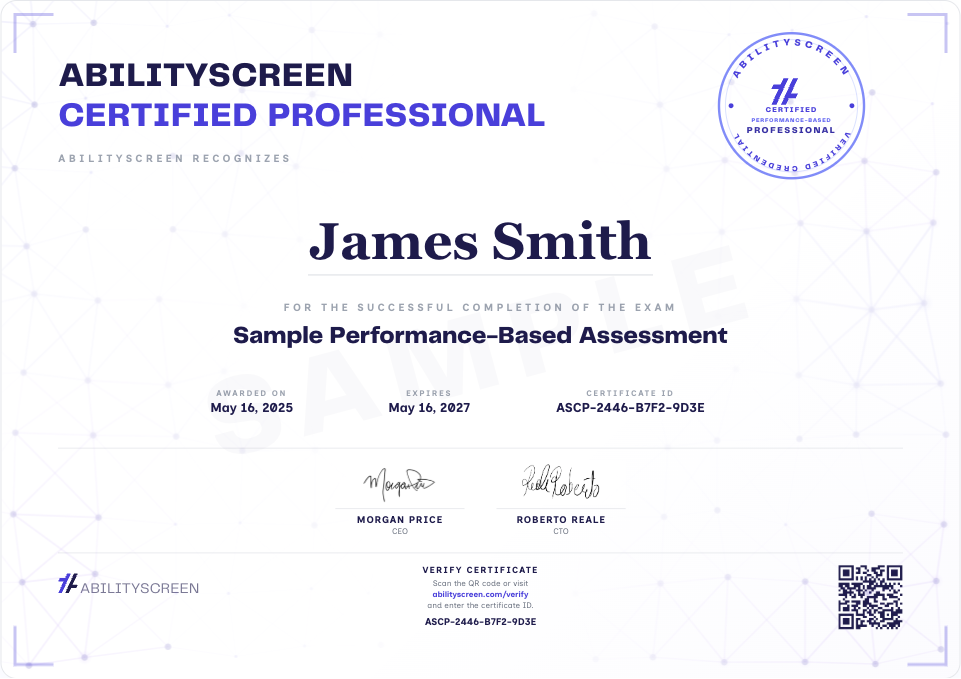
Sample certificate for demonstration purposes. View full details
Ready to prove your skills?
Purchase this assessment and get started today.
$179.00